The PRD loop
The loop zurdo was built around, how it maps onto agile, and how to use it well.
zurdo v1.36.0
Writing PRDs covers the artifact. This page covers the loop you run it in: you keep the engineering judgment and hand the agent only the typing.
The loop
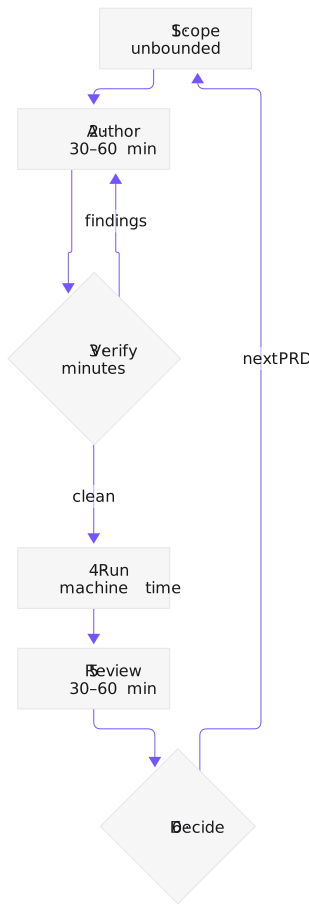
Two properties make it work:
- You're needed only where judgment is irreplaceable: locking the scope and accepting the result. Everything between runs on machine time.
- Verification happens on both sides. The spec is checked before the run and the work after it, so the cheap gate always runs first.
Phase by phase
1 · Scope (unbounded) Research the code, constraints, and failure modes, then lock what will exist when you're done. Take as long as it takes: the scope is a commitment.
2 · Author (30–60 min)
Turn the scope into tasks and criteria with zurdo-prd-author, or scaffold a draft. If this drags, the scope wasn't locked.
3 · Verify the PRD (minutes)
Check that each criterion is honest, falsifiable, and failing today, then run zurdo validate and zurdo analyze. A bad criterion costs a minute here and a whole run later.
4 · Run (machine time)
Start zurdo run, often on a remote server, and walk away. Zurdo checks every hint after every iteration, and Max-Attempts caps the spend.
5 · Review (30–60 min)
Read the diff and sign off [manual] criteria with zurdo review. The criteria proved it works. Review asks whether it's how you'd have built it.
6 · Decide If the evidence holds, merge it yourself (zurdo has no git automation). If a task kept failing, the scope's model of the system was probably wrong: rescope.
Why scoping is the one phase without a timebox
Once a PRD runs, the scope dictates the work and forces you to finish rather than deviate. Zurdo enforces this mechanically:
- The PRD is immutable during a run. A mid-run "actually, let's also…" has no way in.
- Zurdo re-runs every criterion itself, so the definition of done can't drift to match whatever got built.
- Frozen paths fence off evidence the run must not touch.
Deviation isn't suppressed, it's scheduled into the next scoping session. A good scope makes phase 2 transcription, not invention.
The agile correlation
This is the agile cycle with three changes: the sprint shrinks to hours, an agent replaces the team, and every rule agile enforces socially, zurdo enforces mechanically.
| Agile | Zurdo | What changes |
|---|---|---|
| Product backlog | Findings and deferred work for the next scope | Same role |
| Sprint planning | Scope (phase 1) | Still the slow, judgment-heavy phase |
| Story + acceptance criteria | PRD task + hint-typed criteria | Criteria become executable checks |
| Definition of Done | The hints | Checked after every iteration, so nobody can just "call it done" |
| Sprint commitment | The locked PRD | Can't be renegotiated mid-run |
| The sprint | The run | Weeks become hours; Max-Attempts replaces the burndown |
| Daily standup | progress.log + iteration records | Same information, no meeting |
| Sprint review / demo | Review: report, evidence, [manual] sign-off | Gathered evidence replaces "trust me" |
| Retrospective | Decide (phase 6) | Failing criteria are the retro input |
| Velocity | Throughput | Counted in merged scopes, not story points |
Pipelining
The loop doesn't have to be serial. While one PRD runs, author the next, then review both when you're free.
throughput ≈ available attention ÷ (authoring timebox + review timebox)
Implementation time drops out of the equation, and that's the gain, not agent speed. A chat workflow costs your attention every iteration. Here you spend it once on the design and once on the verdict, and you can batch each: design in one block, review in another.
Tracking the loop with Carol
When the work spans several PRDs, or teammates follow it on GitHub, Carol mirrors each edge of the loop: carol scope at scope, carol publish after authoring, carol sync after a run, and carol status at decide. It never runs zurdo, and every write waits for --apply.
Using it well
Zurdo automates the loop, not the thinking. Everything before zurdo run costs little or nothing. It exists to make the token spend land.
Delegate outcomes You own what, where and how you'll know. If you can't name a check a machine can run, you're still in design.
Split by outcome
Each task needs criteria that can fail on their own. Split by verifiable outcome, not by file, and order with Depends-on.
Hint before prose Write each criterion's hint first, and make it fail on today's tree. A criterion green before the run proves nothing.
Freeze the evidence
Put ADRs, lockfiles and generated code under **Frozen** or [verification] protected_paths.
- Validate every PRD, even ones you're sure about. You're most tempted to skip it when rushing, which is when it catches something. In CI,
zurdo validate --strictpromotes nine of the twenty-two lint families to errors,unreviewed-scaffoldandhint-pathamong them. - Never pay for a run to learn what
zurdo analyzewould have told you. It flags hints that run but prove nothing, such as[shell: true]and grep tautologies, and requirements no criterion covers. - Size effort honestly.
**Effort**picks the model. Give hard tasks a realisticMax-AttemptsandAgent-timeout. - Treat green as a claim. Read
run-diff.patch, thepassed-at-preflighttally and any evidence-modified warnings. Only you can judge design and naming. - Disconnect freely. State is resumable, so remote runs survive a dropped session.
- Ship it yourself. Zurdo has no git automation, and that's where your accountability starts. Keep
reports/*.jsonanditerations/*as CI artifacts. - If authoring or review keeps running over, fix the scope. Don't stretch the timeboxes.
Next: Running a PRD